
Countertops · Massachusetts · 2026 Buyer's Guide
Quartz vs. Granite vs. Porcelain Slab:
An Honest 2026 Guide for Massachusetts Homeowners
What is the best kitchen countertop material for Massachusetts homes?
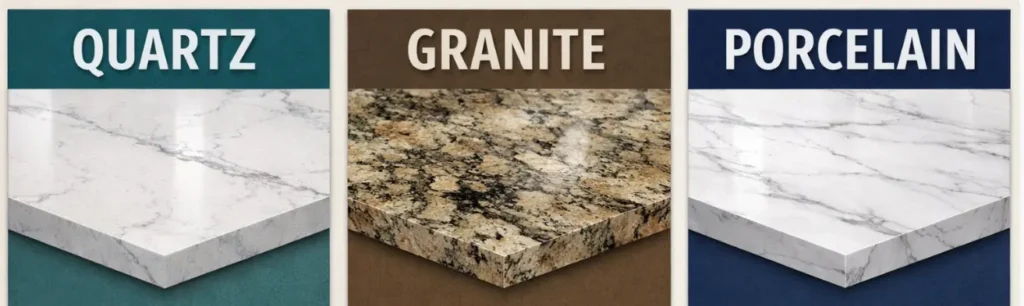
Quartz is the best all-around kitchen countertop material for most Massachusetts homeowners in 2026. It’s non-porous (no sealing required), highly durable, consistent in color, and holds up well to the heavy cooking and family use common in New England homes.
Granite is a strong second choice for homeowners who prefer a natural stone look and don’t mind annual sealing. Porcelain slab is the premium choice — virtually indestructible and heat-resistant — but requires professional fabrication and costs more.
The right answer depends on your lifestyle, your kitchen layout, and your budget. We break all three down in detail below.
Massachusetts Market Trend
61%
of HSH Design clients in 2024 chose quartz as their primary countertop material. 28% chose granite. 11% chose porcelain slab — a number that has tripled in the past three years as porcelain becomes more available and fabricators get comfortable working with it.
The Materials at a Glance
Every kitchen remodel falls somewhere on a spectrum. Here’s how we break it down for our clients at HSH Design, and what’s typically included at each investment level in the Massachusetts market:
Quartz
Granite
Porcelain Slab
Quartz: The Workhorse That Won Massachusetts Kitchens
When you order a quartz slab in “Calacatta Laza,” every section of your countertop will look identical. For homeowners doing L-shaped or island kitchens — which is most of our clients in Wilmington and Burlington — that consistency is a huge visual advantage.
What quartz is great at:
- No sealing required — ever. The resin binder makes quartz non-porous. Red wine, olive oil, tomato sauce, coffee — none of it absorbs into the surface. This is the #1 reason Massachusetts families with young kids choose quartz.
- Scratch resistance. Quartz scores 7 on the Mohs hardness scale. Normal kitchen use won't scratch it — though we still recommend a cutting board (for your knives' sake, not the countertop).
- Consistent color runs. When you need to replace a damaged section years later, you can usually match it.
- Wide price range. Entry quartz (think Silestone or MSI) starts around $65/sq ft installed. Premium brands (Cambria, Caesarstone) run $95–$120.
Where quartz has limitations:
- Heat is its enemy. Unlike granite, quartz can be damaged by direct heat. Placing a hot pan directly from the stove can discolor or crack the resin. Always use trivets. If you cook constantly with cast iron at high heat, take note.
- UV sensitivity. Quartz can yellow or fade with prolonged direct sun exposure. Not a major issue for most kitchens, but relevant for sunroom or outdoor applications.
- It's not natural stone. Some homeowners feel the engineered look lacks the depth of true granite. This is entirely personal — many people can't tell the difference, especially with modern photographic-print quartz designs.

Celia Rodrigues
Bath Vanity & Renovation Client · Google Review · HSH Design Inc.
Granite: The Classic That Refuses to Die
What granite is great at:
- Heat resistance. Set a hot pan directly on granite — it doesn't care. This is a genuine advantage for serious cooks and bakers.
- Unique appearance. No two slabs are identical. If you want something that looks truly handcrafted and organic, granite wins this category over quartz every time.
- Cost. Good quality granite typically comes in slightly under equivalent quartz — often $10–$20/sq ft less installed.
- Scratch resistance. Granite is one of the hardest natural materials — it's difficult to scratch with normal kitchen tools.
Where granite has limitations:
- It requires annual sealing. Granite is porous. Without sealing, it will absorb liquids over time — and red wine or cooking oil stains that soak in can be permanent. With proper sealing (15–30 minutes, once per year), this is manageable — but it's a maintenance commitment quartz doesn't require.
- Color matching is nearly impossible. If you crack a granite countertop and need to replace one section, matching the slab exactly is extremely difficult. Each slab is unique.
- Radon concerns (minimal, but real). Some granite varieties contain naturally occurring trace levels of uranium and emit tiny amounts of radon. The EPA notes that granite countertops are unlikely to be a significant radon source, but it's worth knowing.
Janet’s take on granite in Massachusetts: “Granite is still a beautiful, smart choice for families who love to cook and want that real-stone organic look. The maintenance question is simple: if you’re the type of person who keeps up with household maintenance, granite is no big deal. If ‘annual sealing’ sounds like a chore you’ll skip, go with quartz.”
Want to See All Three Side by Side?
Porcelain Slab: The Fastest-Growing Choice in New England
What porcelain slab is great at:
- Zero maintenance. Porcelain is non-porous, doesn't need sealing, doesn't react to acids or alkaline cleaners. A damp cloth is genuinely all it needs.
- Heat resistance. Like granite, you can set hot pans directly on it without concern. This is a major advantage over quartz.
- UV resistance. Unlike quartz, porcelain won't fade or yellow in direct sunlight. It's equally suitable for indoor and outdoor kitchens.
- Dramatic large-format appearance. Bookmatched porcelain (two slabs mirrored like an open book) creates a stunning continuous vein pattern impossible to replicate in natural stone.
- Scratch resistance. Porcelain rates 8–9 on the Mohs scale — harder than granite.
Where porcelain has limitations:
- Fabrication requires specialist expertise. Porcelain slab is difficult to cut and drill without chipping — it requires diamond-tipped CNC machinery and experienced fabricators. Not all fabricators in Massachusetts work with it confidently yet. This is a real installation risk if you choose the wrong team.
- Premium cost. Material and installation runs $80–$140/sq ft — noticeably more than quartz or granite at comparable tiers.
- Chipping on edges. The edges of porcelain slab (particularly at sinks and corners) can chip if subjected to sharp impact. Standard edge profiles help minimize this risk.
2025 Trend Data
+214%
Head-to-Head: The Full Comparison
| Feature | Quartz | Granite | Porcelain Slab |
|---|---|---|---|
| Installed cost (MA) | $65–$120/sq ft | $55–$100/sq ft | $80–$140/sq ft |
| Sealing required? | ✓ No | ✗ Annually | ✓ No |
| Heat resistance | ⚠ Use trivet | ✓ Excellent | ✓ Excellent |
| Scratch resistance | Very high | Very high | Highest |
| UV / outdoor use | ✗ Will fade | ✓ Fine | ✓ Excellent |
| Color consistency | Excellent | Varies (natural) | Excellent |
| Natural stone look | Good (engineered) | Best (it IS stone) | Very good (printed) |
| Resale appeal | Very strong | Strong | Strong (growing) |
| Installation difficulty | Standard | Standard | Specialist required |
| Lifespan | 20–30 years | Lifetime | Lifetime |
How to Actually Decide: The Right Material for Your Kitchen
Choose based on how you live:
Donna Vigneau
Full Kitchen Remodel Client · Google Review · HSH Design Inc.
What Will This Actually Cost for Your Massachusetts Kitchen?
For a standard kitchen with 45 square feet of countertop surface — typical for a Wilmington or Burlington colonial with an island — here’s what each option runs in 2026:
| Material Tier | Quartz (installed) | Granite (installed) | Porcelain Slab (installed) |
|---|---|---|---|
| Entry-level | $3,000–$4,500 | $2,500–$3,800 | $3,600–$5,000 |
| Mid-range | $4,500–$7,000 | $3,800–$6,000 | $5,000–$8,500 |
| Premium | $7,000–$10,000+ | $6,000–$9,000+ | $8,500–$14,000+ |
Frequently Asked Questions
Is quartz better than granite for a Massachusetts Kitchen?
“Better” depends on your lifestyle. Quartz is better for low maintenance — no sealing, stain-resistant, consistent color. Granite is better if you cook heavily with direct heat, prefer a one-of-a-kind natural look, or are working with a tighter budget. Both are excellent choices for Massachusetts homes.
Does quartz increase home value in Massachusetts?
Yes. Quartz and granite countertops are among the top ROI kitchen improvements for Massachusetts homeowners. According to the 2024 Cost vs. Value Report for New England, a mid-range kitchen remodel — which typically includes new countertops — returns 72–80% of cost at resale. Buyers in the $600K+ Massachusetts market expect stone countertops.
How do i know if i have quartz or granite countertops now?
The simplest test: look at the edge. Granite patterns continue all the way through the thickness of the slab — the edge pattern will match the surface. Quartz often has a slightly different appearance at the edge because the engineered material may show a uniform color there. You can also try the water test: put a few drops of water on the surface. If it beads up, it’s likely sealed granite or quartz. If it absorbs, it’s unsealed granite that needs attention.
Can i see the actual slabs before buying?
Yes — and you should. At HSH Design in Wilmington, we have sample panels of our quartz, granite, and porcelain slab options. For final selection on granite, we strongly recommend going to the stone yard to pick your actual slab — because granite varies slab by slab, and the one you choose will be the one on your counter for the next 30 years. We can arrange this as part of your project process.
How long does countertop installation take?
Countertop fabrication and installation typically takes 2–4 weeks from template to installation. The fabricator first creates a precise template of your cabinets (after installation), then cuts and finishes the slabs, then installs them. The actual installation day is usually 4–8 hours depending on kitchen size and complexity.
Come Touch the Difference at Our Wilmington Showroom
Or just stop in — we’re at 37 Lowell Street, Wilmington, MA · (978) 375-7685