Small Bathroom Remodel Ideas That Maximise Space Without Moving Walls

A small bathroom does not have to feel like a cupboard with a tap. Whether you are dealing with a 35-square-foot powder room or a compact suite, the right remodel can make the space feel twice as large – without knocking down a single wall, hiring a plumber to reroute pipes, or blowing your budget on structural work. The secret lies in smart design choices: what you put on the walls, where you store things, how light moves through the room, and which fixtures you choose.
This guide covers practical, high-impact small bathroom remodel ideas that homeowners, renters upgrading their space, and property investors can implement right now. No structural engineering required.

1. Go Vertical: Clever Storage That Does Not Eat Floor Space
Go Vertical Remodel
Floor space is the most precious commodity in a small bathroom. The moment you add a freestanding storage unit, a laundry basket, or a bulky vanity, you reduce the visual footprint and make the room feel cramped. The solution is to think vertically and recessed.
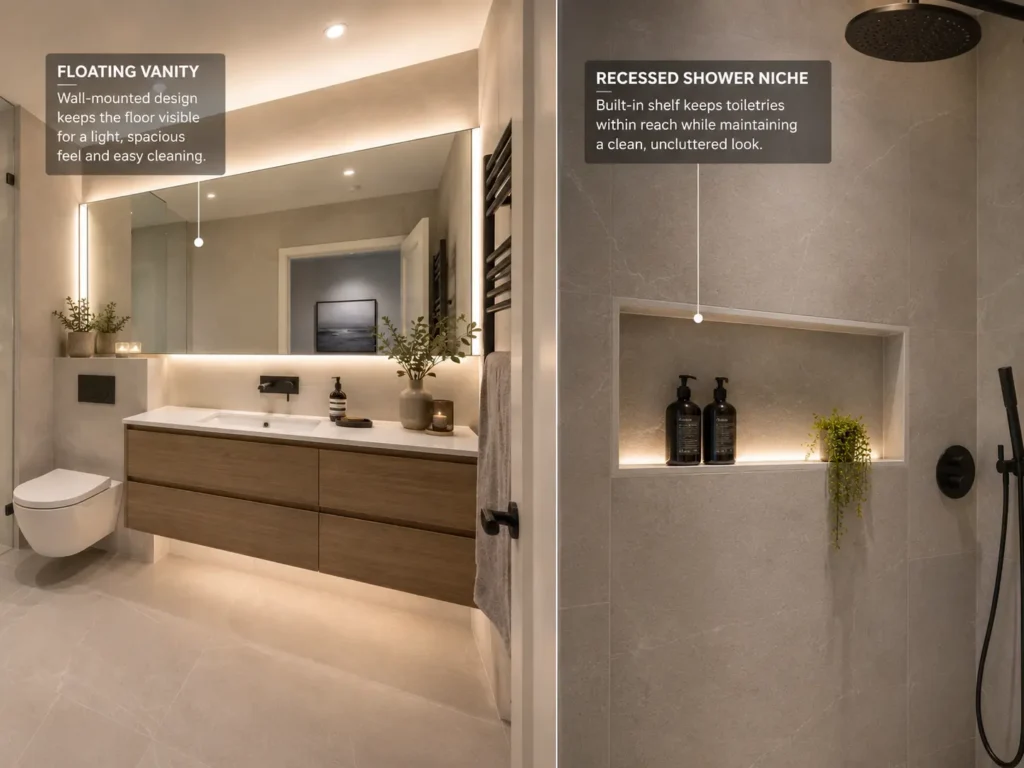
Floating vanities are one of the single best investments you can make in a small bathroom remodel. By mounting the cabinet off the floor, you expose the floor beneath it – which tricks the eye into reading the room as larger. A floating vanity with two deep drawers gives you more usable storage than a pedestal sink with a basket shoved underneath, and it keeps the floor clear for mopping.
Tall slim cabinets that run floor to ceiling maximise the dead zone above head height. A 20-25 cm deep cabinet beside the toilet or in a corner can hold towels, cleaning products, and spare toiletries in a footprint smaller than a standard bath towel. Pair this with a mirrored cabinet above the sink for a double layer of storage that adds depth rather than bulk.

Tall slim cabinets that run floor to ceiling maximise the dead zone above head height. A 20-25 cm deep cabinet beside the toilet or in a corner can hold towels, cleaning products, and spare toiletries in a footprint smaller than a standard bath towel. Pair this with a mirrored cabinet above the sink for a double layer of storage that adds depth rather than bulk.

2. Mirrors and Lighting: The Fastest Way to Double a Room
Mirrors and Lighting for Bathroom Remodel
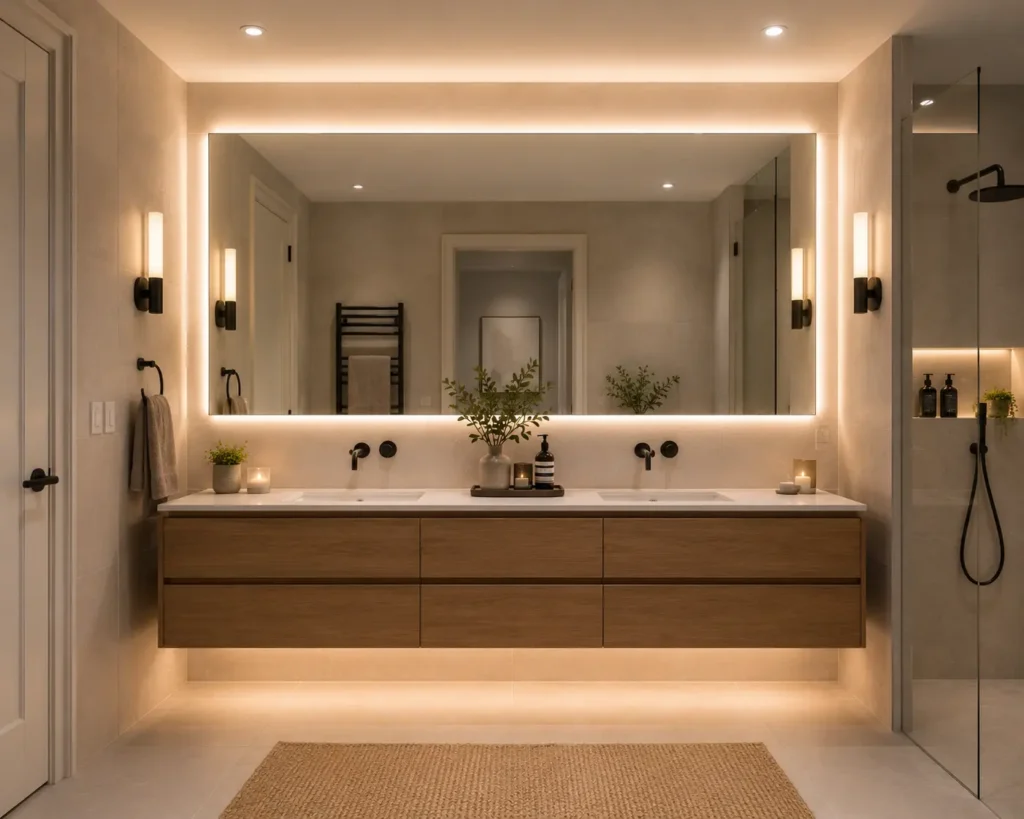
If there is one design tool that delivers the biggest return on a small bathroom remodel, it is mirror placement. A full-width mirror – running the entire length of the vanity wall – creates an illusion of a room that is twice as wide. It reflects light, bounces colour, and gives the eye a vanishing point that does not exist in a narrow space.
Large-format mirrors that reach from counter height to the ceiling are particularly effective in bathrooms with low ceilings. By drawing the eye upward, they add perceived height. If your bathroom has an awkward alcove or an unused wall, consider covering it with a frameless mirror panel – the wall appears to dissolve, and the room feels open.
Lighting is the other half of this equation. Most small bathrooms rely on a single overhead bulb, which creates unflattering shadows and makes the room feel dim and enclosed. Layered lighting – a combination of overhead, task, and accent sources – transforms the atmosphere.
Choose warm-white bulbs (2700–3000 K) rather than cool-white for an inviting, spa-like feel. Cool lighting in a small space can feel clinical and harsh, which subconsciously makes the room feel less comfortable and therefore smaller.

3. Space-Smart Fixtures and Fittings That Work Harder
Smart Fixtures for Bathroom Remodeling

The fixtures you choose determine more than aesthetics – they define how the room functions and how much space you have left over for movement. In a small bathroom remodel, every centimetre matters, and the right product choices can reclaim surprising amounts of floor and wall space.

Toilets

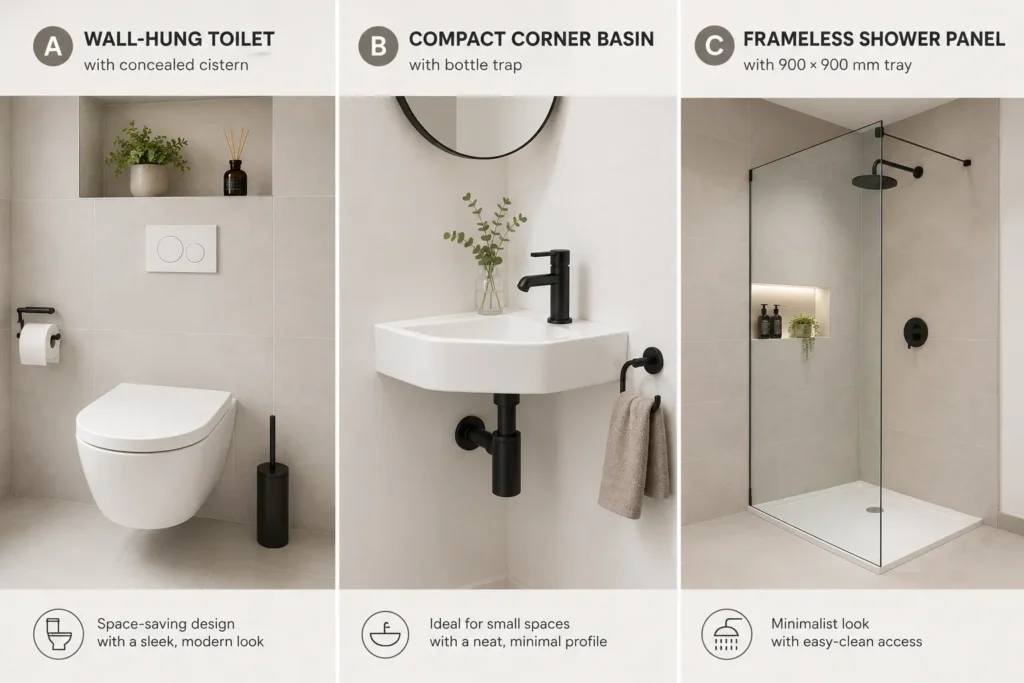
Wall-hung (back-to-wall) toilets are a game-changer in compact bathrooms. Because the cistern is concealed inside the wall cavity, you save 15-20 cm of floor depth compared with a standard close-coupled suite. That is enough extra clearance to walk comfortably past, or to fit a slightly wider vanity. Compact close-coupled toilets – sometimes called short-projection suites – are a more budget-friendly alternative, projecting as little as 60 cm from the wall.

Basins

Corner basins use a triangular footprint to fit into an otherwise wasted corner. Cloakroom basins – the narrow units designed for under-stair WCs – can work beautifully in a small en suite when paired with a generous mirror and good lighting. Wall-mounted basins with a bottle trap (rather than a pedestal or cabinet) expose the floor completely, reinforcing the open feel.

Shower Enclosures

If your bathroom has a bath you rarely use, replacing it with a walk-in shower is the single most space-liberating change you can make – without moving a wall. A 900 × 900 mm shower tray in the same footprint as a standard bath end frees up 40-50% of the floor area. Frameless glass panels maintain sightlines across the full width of the room, whereas framed or semi-framed screens visually cut the space in half. If a full enclosure is not possible, a simple fixed glass screen on a wet-room-style level-access area achieves a similar open effect.
Sliding or bifold shower doors are better than hinged doors wherever clearance is limited – a hinged door needs 700-800 mm of swing space in front of it, which in a small bathroom is often impossible to achieve.

4. Tiles, Colour, and Visual Tricks That Change Everything
Surface treatment – tile choice, grout colour, and paint palette – is where many homeowners under-invest in a small bathroom remodel, yet it is one of the highest-leverage decisions you can make. The visual tricks here are well-established by interior designers and backed by the psychology of spatial perception.
Tiles and Colors for Bathroom Remodeling

Large-Format Tiles

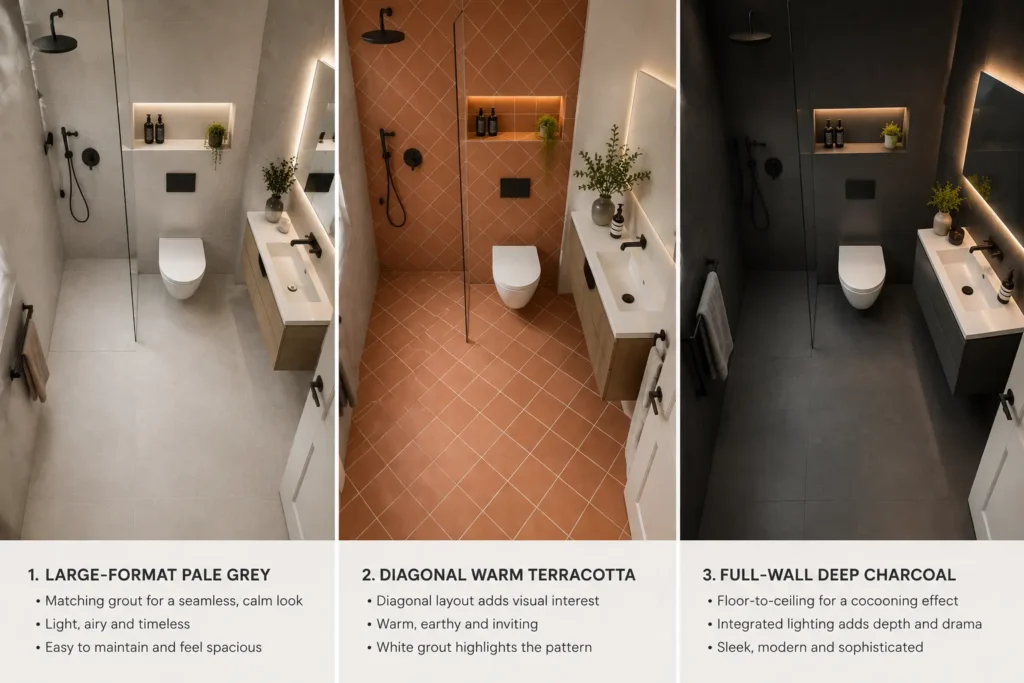
Counter-intuitively, large tiles – 600 × 600 mm or even 1200 × 600 mm rectified porcelain – make a small bathroom feel bigger, not smaller. Fewer grout lines mean fewer visual interruptions across the floor and walls. The eye reads the surface as a single continuous plane, which expands the perception of space. Small mosaic tiles, by contrast, create hundreds of interrupting lines that chop up the surface and make the room feel busier.

Tile Direction and Layout

Running floor tiles at a 45-degree diagonal makes a narrow room appear wider. Laying rectangular tiles horizontally (landscape orientation) on a wall lengthens the wall visually. Running the same tile vertically adds height. Choosing floor and wall tiles in the same colour family – or even the same tile format throughout – eliminates the visual horizon line where floor meets wall, creating a seamless cocoon effect.

Colour Strategy

Light colours reflect more light and recede visually, making surfaces feel further away. This is why white, off-white, pale grey, and soft sage remain the most popular choices in small bathrooms. However, do not be afraid of darker tones – a bathroom tiled entirely in deep charcoal or forest green can feel luxuriously enveloping rather than claustrophobic, provided the lighting is thoughtful. The mistake to avoid is two-tone schemes with a sharp contrast line at dado height, which cuts the room in half vertically.
Match grout colour to tile colour wherever possible. Contrasting grout emphasises every joint line, which multiplies visual interruptions. A near-matching grout creates the smooth, continuous surface that makes the room feel larger.

5. Wet Room and Shower Upgrades: Maximum Impact, Minimum Footprint
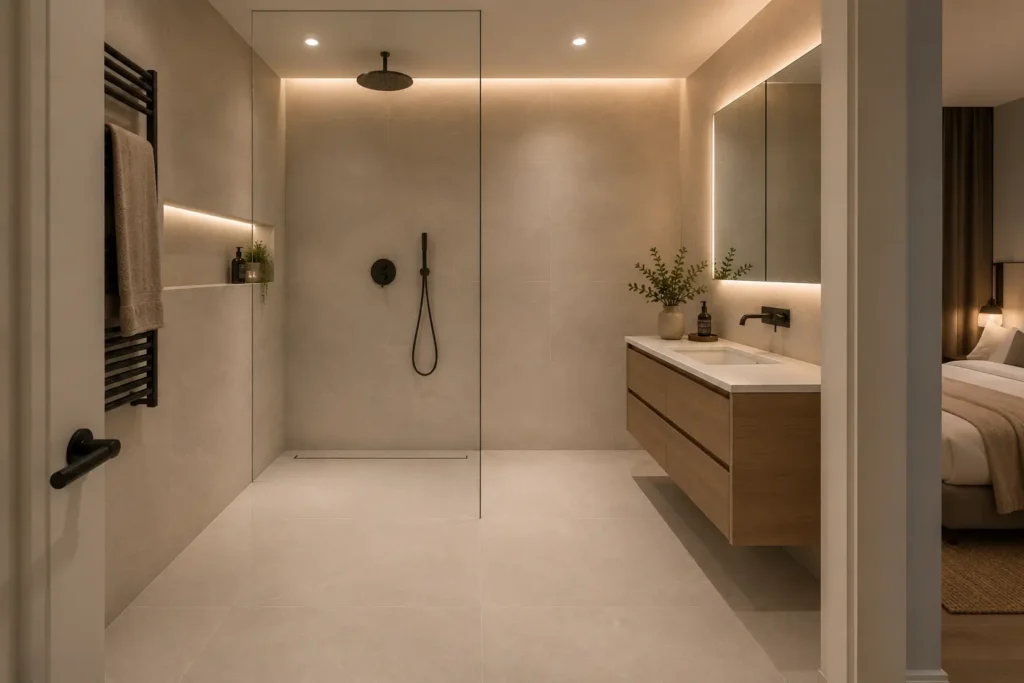
Wet Room Shower
Converting an ordinary shower cubicle – or even the bath zone – into a level-access wet room is one of the most popular small bathroom remodel projects of the last decade. The reason is simple: removing the shower tray lip and the enclosure frame eliminates physical and visual barriers, making the entire floor area feel usable and contiguous.
A properly tanked wet room with a linear drain running along one wall (rather than a central floor drain) allows the floor tile to run continuously from the shower zone into the main bathroom floor. A single glass screen – fixed, frameless, and minimal – defines the wet area without enclosing it. The effect is a bathroom that looks and functions like a high-end hotel suite.
Rainfall showerheads add a spa feel without additional plumbing runs – most can be connected to your existing supply with a simple overhead arm. Thermostatic shower valves with separate body jets and a handheld are not much more expensive than a standard mixer valve and dramatically upgrade the daily experience of the space.
If a full wet room is beyond your budget, a low-profile 25 mm shower tray in matching tile colour achieves a similar visual effect at a fraction of the cost. The key is choosing a tray colour that is indistinguishable from the surrounding floor tiles so the eye does not register a boundary.

6. Planning and Budgeting: Getting the Most from Your Remodel
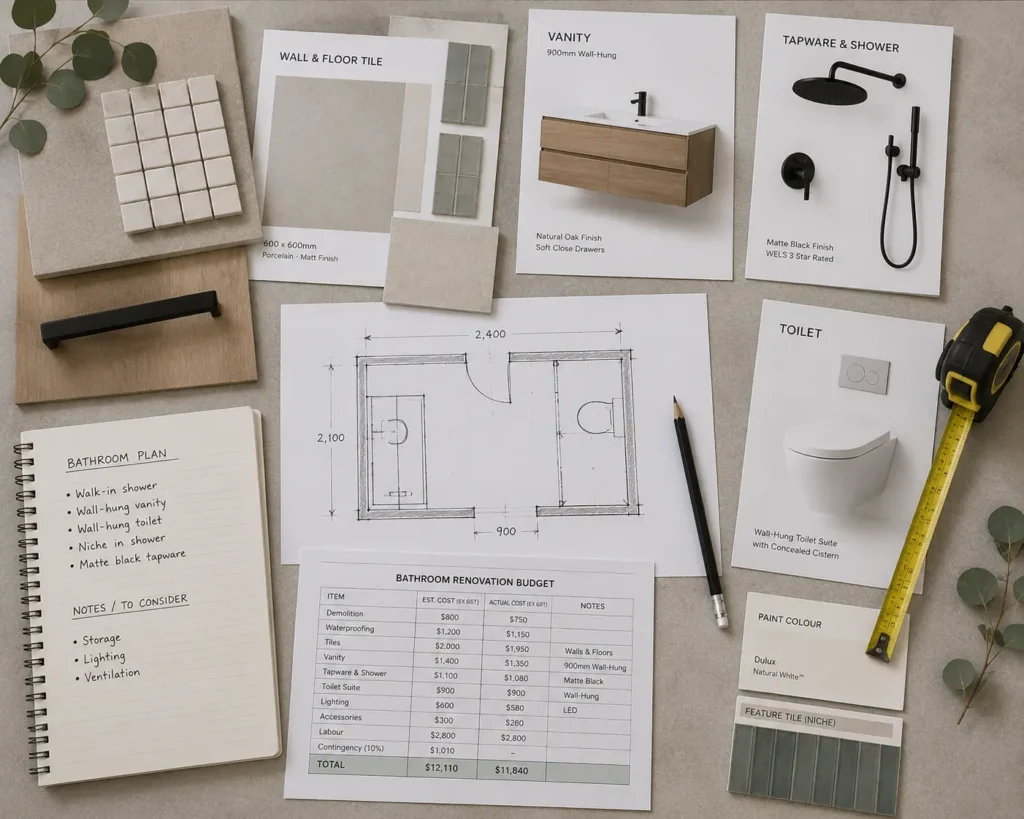
A small bathroom remodel without structural work is genuinely one of the best value-for-money home improvement projects available. According to industry data, bathroom renovations consistently return between 60-80% of their cost in added property value, with small bathroom remodels often performing better proportionally than large ones because the starting point is lower.
Planning and Budgeting for Bathroom Remodel

Set Your Priorities Before You Shop

The biggest budgeting mistake in bathroom remodels is spending equally across every element rather than concentrating spend where it makes the most visual and functional difference. Allocate your budget in roughly this order of priority:
The shower is what you use every day and what guests notice first – it deserves the majority of your spend.

Keep Plumbing in Place

Moving soil pipes, waste outlets, or supply feeds is expensive and often requires opening floors or walls. Unless there is a compelling functional reason to relocate a fixture, keep everything where it is and work with the existing layout. Modern bathroom design has ample tools to make any layout look deliberate and well-planned – you do not need to reroute plumbing to achieve a beautiful result.

Get the Sequence Right

The correct sequence for a small bathroom remodel is: strip out → first-fix electrics and plumbing → tanking and waterproofing → tiling (floor, then walls) → second-fix electrics → sanitary ware installation → accessories and finishing. Getting this sequence wrong – for example, tiling before tanking or fitting the toilet before the floor tiles are laid-creates expensive re-work. If you are managing tradespeople yourself, agree the sequence in writing before work begins.

Where to Spend vs. Save

Spend on: tiles (they last decades and define the room), the shower valve and tray, and the mirror or cabinet. Save on: toilet roll holders, towel rings, and toilet seats – quality chrome accessories are available at all price points. Also save on: the toilet itself – the difference between a £150 and a £500 toilet is mostly brand name, not performance, and nobody scrutinises the pan when they visit your home.

7. Ten Quick Wins You Can Do This Weekend
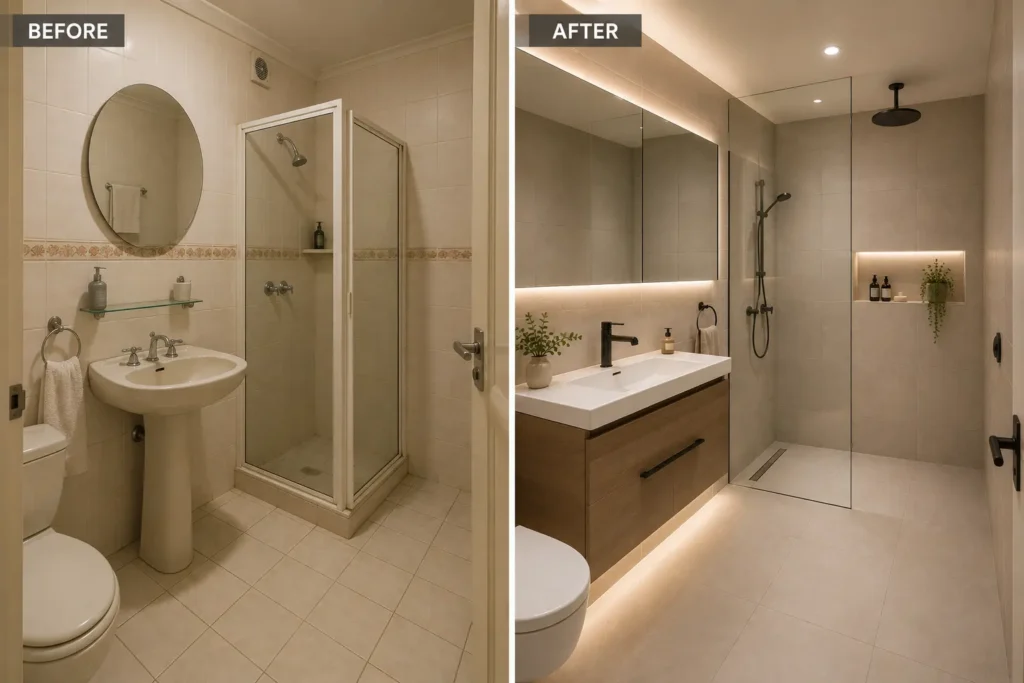
Not every improvement requires a full remodel. If budget or timing is tight, these high-impact changes can be done in a weekend with minimal trade involvement:
Before After Bathroom Remodel

Conclusion: Small Space, Big Potential

A small bathroom remodel that avoids structural work is not a compromise – it is a constraint that forces creative, high-leverage decisions. The most impactful changes in this guide cost less and disrupt your home for less time than moving a single wall, yet the results are indistinguishable from a full gut renovation when executed well.
Start with the elements that do the most visual work: a large mirror, layered lighting, and frameless glass in the shower zone. Build from there with smart storage, right-sized fixtures, and a coherent tile palette. Keep the plumbing where it is, concentrate your spend on what you see and touch every day, and get the installation sequence right.
Whether you are renovating a tired rental property, preparing your home for sale, or simply ready to stop dreading your morning routine, these ideas give you a clear, practical roadmap. The square footage is fixed. Everything else is a design decision.

Frequently Asked Questions

Can I really make a small bathroom feel bigger without knocking down walls?

Yes – and most designers argue that layout-free remodels produce better results per pound spent than structural ones. The biggest gains come from mirrors, frameless glass, large-format tiles, and smart lighting. These changes affect how the eye reads the space, not the actual square footage.

In the United States, the cost of a small bathroom remodel typically ranges from $5,000 to $15,000, depending on the scope of work, materials, and labor rates in your area.

  • Basic refresh ($5,000–$8,000): New paint, fixtures, vanity, mirror, lighting, and minor updates while keeping the existing layout.
  • Mid-range remodel ($8,000–$15,000): New flooring, vanity, toilet, shower or tub updates, quality tile, and upgraded finishes.
  • High-end remodel ($15,000–$30,000+): Custom cabinetry, premium tile, luxury fixtures, wet room conversion, or significant plumbing and electrical work.

In most cases, yes – especially if you rarely use the bath. A walk-in shower in the same footprint frees up 40-50% of the floor area and dramatically changes how the room feels. The only exception is if you are likely to sell soon and your buyer demographic expects a bath (families with young children, for example). In that scenario, consider keeping the bath and focusing improvements elsewhere.

Larger tiles — 600 × 600 mm or bigger — are generally better for small bathrooms because they create fewer grout lines and less visual noise. Match the grout colour to the tile colour to maximise the effect. Small mosaics can work as an accent or shower niche feature, but avoid using them across the entire floor or wall.

In the US, most bathroom remodels do not require planning permission because they are classed as permitted development and take place inside the existing envelope of the building. However, any work involving electrics in a bathroom must comply with Part P of the Building Regulations and should be carried out by a qualified electrician who can self-certify, or notified to your local authority. If you are in a flat, check your lease before moving any drainage.

A straightforward retile-and-refixture job with an experienced bathroom fitter typically takes five to seven working days. A wet room conversion or full strip-out with new waterproofing, tiling, and sanitary ware usually runs ten to fourteen working days. Add buffer time if you are coordinating multiple trades (plumber, electrician, tiler) yourself.

Light, neutral tones – white, off-white, pale grey, soft sage – reflect the most light and make a small space feel airy. That said, a fully dark bathroom (charcoal, navy, deep forest green) can feel luxurious rather than cramped if the lighting is well-planned. The scheme to avoid is a sharp two-tone split at dado height, which cuts the room visually in half.

Cosmetic work – painting, swapping accessories, replacing a mirror, adding LED strips – is well within DIY reach. Tiling is achievable with preparation and patience. However, anything involving water supply, drainage, or electrics in a wet zone should be handled by qualified tradespeople. Getting waterproofing wrong is the most expensive bathroom mistake you can make, and it may not show up until mould or structural damage appears months later.

Ready to Plan Your Kitchen Remodel?

Cabinet hardware is one of those decisions that seems minor until you live with it every day. The right choices mean your kitchen will feel and function beautifully for years to come. The wrong ones are an expensive, frustrating fix.
At HSH Design Inc., we specialize in custom cabinetry and full kitchen remodels for homeowners across Wilmington, Andover, Reading, and surrounding Massachusetts communities. Our team will guide you through every hardware decision — from soft-close hinges and full-extension slides to the perfect finish for your lifestyle and design vision.
Visit our showroom, give us a call, or drop us an email to get started. We’d love to help you build a kitchen you’ll love for years to come.

Visit HSH Design Inc.

HSH Design Inc.
442 Main Street, Wilmington, MA 01887
📞 (978) 375-7685
✉ janet@hshdesigninc.com

Mon–Thu: 10 AM–5 PM | Fri: 10 AM–3 PM | Sat: By Appointment

Products and Services

How can we help you?

Scroll to Top