Karen had been planning her Wilmington kitchen remodel for two years.
She had done everything right. She spent months choosing her cabinetry — a warm, two-tone combination with natural oak lowers and a soft white upper. She selected a honed quartzite countertop that caught the light beautifully in the showroom sample. She chose a handmade ceramic tile backsplash that her designer called "the most characterful backsplash I have seen this year. Her appliances were professional-grade. Her island was exactly the size she had always wanted.
Six weeks after the project was complete, she called us. It doesn’t look like I thought it would
she said. Something is off and I can’t figure out what.
We already knew the answer before we arrived. It almost always is the same answer: the lighting.
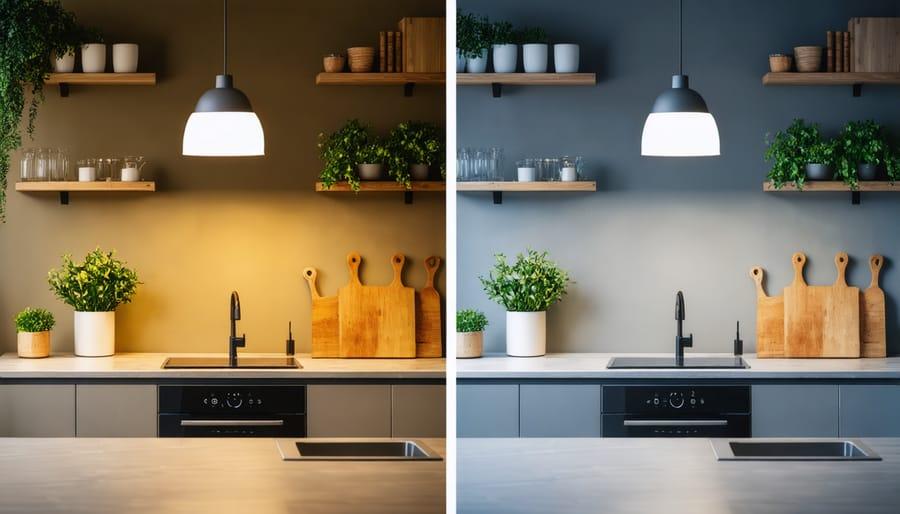
Karen’s contractor had installed eight recessed downlights in a grid across the ceiling and called it done. No under-cabinet lighting. No pendants over the island. No consideration of how the warm oak tones, the matte quartzite, or the handmade tile would read under overhead-only illumination. The space that had looked stunning in the showroom looked flat, shadowless, and strangely institutional in her home.
Her remodel cost over $80,000. The lighting budget was $600.
rank high-quality lighting as one of their top priorities in a kitchen remodel — yet it is consistently the last decision made and the first place budgets get cut.
Source: NKBA 2026 Kitchen Trends Report — survey of 634 designers, remodelers, and architects
Most homeowners think about lighting as a finishing touch. Choose some fixtures, plug them in, and the room is done. But professional designers and architects know something that most homeowners learn only after the fact: lighting is not a finishing touch. It is the filter through which every other design decision is experienced
The cabinet color you fell in love with in the showroom was lit by carefully designed display lighting, positioned to bring out the warmth of the wood grain and the depth of the finish. Your quartzite countertop samples looked luminous because they were backlit and spot-lit at angles specifically chosen to show the movement in the stone. That handmade tile came alive under the right temperature of light.
Take those same materials home, flood them with overhead grid lighting, and you will have a beautiful, expensive kitchen that nobody will ever describe as beautiful.
In Wilmington, Burlington, Woburn, Reading, and Billerica, we see this pattern constantly. Homeowners invest serious money in quality materials and skilled craftsmanship — and then leave the lighting plan to the last week of a six-month project, or hand it entirely to an electrician who has never been asked to think about design.
The good news is that it is entirely preventable. But only if lighting is treated as a design decision, not a logistics one — and only if it happens at the beginning of your remodel, not the end.
say they use lighting specifically to improve their physical and mental wellbeing — making it a wellness decision as much as a design one.
The reason most residential kitchens look underwhelming — regardless of the quality of materials inside them — comes down to a single omission: they rely on a single layer of light.
The reason most residential kitchens look underwhelming — regardless of the quality of materials inside them — comes down to a single omission: they rely on a single layer of light.
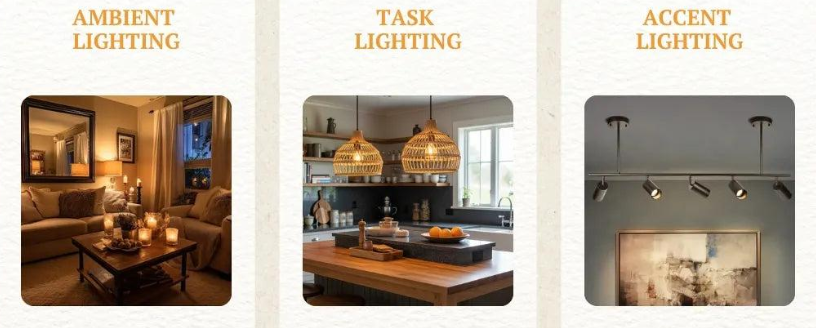
Ambient lighting is your room's general illumination — the base level of light that makes the space usable. For most kitchens, this means recessed downlights, a ceiling fixture, or both. The mistake most homeowners make is stopping here. Ambient lighting alone creates flat, even illumination that eliminates shadows — and it is shadows, used intentionally, that create the sense of depth and dimension that make a room feel designed rather than merely lit.
For Wilmington homes with open-plan kitchens that flow into living or dining areas, your ambient lighting scheme also needs to account for how the kitchen light interacts with the adjoining space — including color temperature transitions that can make a beautifully designed open floor plan look disjointed if handled carelessly.
Task lighting is placed specifically where work happens: under cabinets to illuminate countertops and prep zones, inside deep drawers or pantry cabinets so nothing disappears into shadow, and directly over the sink and cooking surface. It is the most practical layer of a lighting plan and, along with pendants over an island, the most immediately noticeable when missing.
Accent lighting is where design intention becomes visible. It includes interior cabinet lighting that turns glass-front uppers into display features, backsplash lighting that draws attention to tile work you paid a premium to select, toe-kick lighting that creates a sense of the kitchen floating above the floor, and decorative fixtures — pendants, sconces, statement ceiling pieces — that serve as focal points in their own right.
This is the layer that makes the difference between a kitchen that looks expensive and one that looks designed. It is also, not coincidentally, the layer that requires the most coordination with your cabinetry, countertop, and tile selections — which is exactly why it needs to be planned at the beginning of the project, not specified from a fixture catalogue in the final week.
If kitchen lighting is most often under-planned, bathroom lighting is most often mis-planned. And the consequences are not merely aesthetic — they are functional in ways that affect daily life in the most direct possible sense.
The most common mistake in bathroom lighting design across Wilmington and the surrounding towns is placing the primary light source directly above the vanity mirror. Overhead-only bathroom lighting creates what designers call the mortuary effect — strong downward shadows that fall across the face, accentuating under-eye hollows, sharpening jawlines, and making makeup application, shaving, and grooming genuinely difficult.
Correct vanity lighting places light sources at eye level, on either side of the mirror — or withi the mirror itself, using integrated LED mirror designs that are now among the most requested features in the bathroom remodels we see across Reading, Tewksbury, and Bedford. This eliminates facial shadows entirely and creates the balanced, neutral illumination that grooming routines actually require.
say lighting quality is the top consideration in bath design for 2026 — above tile, fixtures, and storage. Layered lighting with eye-level vanity sources is now the standard expectation in primary bath remodels.
Beyond the vanity, a complete bathroom lighting plan for a Wilmington remodel should account for shower lighting (particularly important as larger walk-in showers without enclosures become the dominant design), ambient ceiling illumination that is dimmable for evening use, and — in primary baths — the increasingly popular transition from bright, cool morning light to warmer, softer evening tones.
This last feature, adjustable color temperature throughout the day, is now one of the most- requested bath upgrades we see from homeowners in Wilmington, Burlington, and Woburn. It is no longer a smart-home novelty. It is a daily quality-of-life improvement that bathrooms designed as personal wellness spaces increasingly require.
Here is what every homeowner planning a kitchen or bath remodel in the Wilmington area needs to understand: some lighting decisions are reversible, and some are not. Knowing the difference is the key to avoiding Karen's situation.
The lighting conversation in kitchen and bath remodeling has changed significantly in the last two years. Homeowners walking into ourWilmington showroom are more informed, more specific in what they want, and more aware of what goes wrong when lighting is treated as an afterthought.
The requests we hear most consistently from homeowners in Wilmington, Burlington, Woburn, Reading, Billerica, Tewksbury, Bedford, and Wakefield planning remodels in 2026:
Kitchen upgrades consistently earn a perfect 10 out of 10 Joy Score in the National Association of Realtors remodeling satisfaction research. The homeowners who report the highest satisfaction are almost always those whose lighting was planned as a central part of the design — not a late addition to it.
Joy Score — the maximum possible satisfaction rating — awarded to kitchen upgrades by homeowners who completed remodels. Lighting is consistently cited among the features that make the difference between a satisfying result and a disappointing one.
If you are planning a kitchen or bathroom remodel in Wilmington, Burlington, Woburn, or anywhere in the surrounding area, the single most important thing you can do before meeting with a contractor is to sit down with a designer who will treat your lighting as a design question — not an electrician’s checklist.
At HSH Design Inc., our showroom at 442 Main Street in Wilmington is built specifically for this kind of integrated planning. We carry cabinets, tile, countertops, hardware, and fixtures — and our design consultations are structured to walk you through lighting decisions in the same conversation as material and finish selections, because that is the only way the two can genuinely be coordinated.
We serve homeowners throughout Wilmington, Burlington, Reading, Woburn, Billerica, Tewksbury, Bedford, and Wakefield. Our consultations are complimentary. There is no obligation to purchase, and no high-pressure sales process — just an honest conversation about your project, your home, and how to get the result you have been imagining.
If you have been sitting on plans, collecting inspiration photos, or waiting for the right moment to start — this is it. Kitchen and bath remodeling demand across Massachusetts remains strong heading into 2026, and lead times for quality cabinetry and custom tile are running longer than they were two years ago. Starting the design conversation now puts you in the best possible position to begin your project on your timeline, not your contractor’s
Visit our showroom at 442 Main Street, Wilmington, MA to see cabinets, tile, countertops, and fixtures together — and to build a lighting plan that makes every material you choose look exactly as beautiful at home as it does in person.