

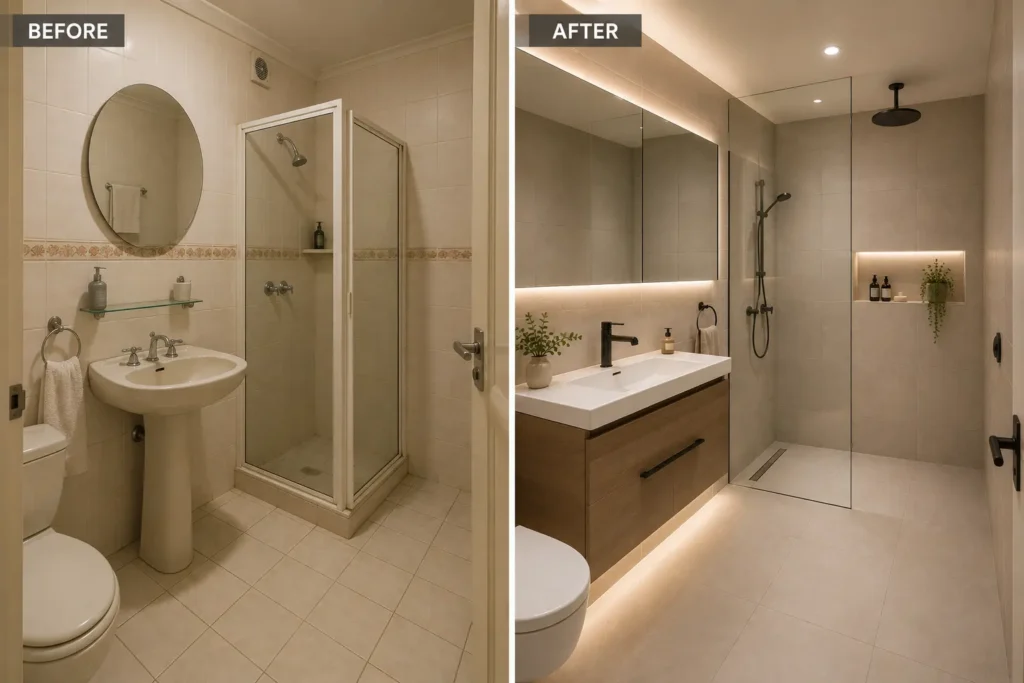
Small Bathroom Remodel Ideas That Maximise Space Without Moving Walls
Small Bathroom Remodel Ideas That Maximise Space Without Moving Walls A small bathroom does not have to feel like a cupboard with a tap. Whether you are dealing with a 35-square-foot powder room or a compact suite, the right remodel can make the space feel twice as large – without knocking down a single wall, hiring a plumber to reroute pipes, or blowing your budget on structural work. The secret lies in smart design choices: what you put on the walls, where you store things, how light moves through the room, and which fixtures you choose.This guide covers practical, high-impact small bathroom remodel ideas that homeowners, renters upgrading their space, and property investors can implement right now. No structural engineering required. 1. Go Vertical: Clever Storage That Does Not Eat Floor Space Floor space is the most precious commodity in a small bathroom. The moment you add a freestanding storage unit, a laundry basket, or a bulky vanity, you reduce the visual footprint and make the room feel cramped. The solution is to think vertically and recessed.Floating vanities are one of the single best investments you can make in a small bathroom remodel. By mounting the cabinet off the floor, you expose the floor beneath it – which tricks the eye into reading the room as larger. A floating vanity with two deep drawers gives you more usable storage than a pedestal sink with a basket shoved underneath, and it keeps the floor clear for mopping.Tall slim cabinets that run floor to ceiling maximise the dead zone above head height. A 20-25 cm deep cabinet beside the toilet or in a corner can hold towels, cleaning products, and spare toiletries in a footprint smaller than a standard bath towel. Pair this with a mirrored cabinet above the sink for a double layer of storage that adds depth rather than bulk. Tall slim cabinets that run floor to ceiling maximise the dead zone above head height. A 20-25 cm deep cabinet beside the toilet or in a corner can hold towels, cleaning products, and spare toiletries in a footprint smaller than a standard bath towel. Pair this with a mirrored cabinet above the sink for a double layer of storage that adds depth rather than bulk. Pro tip: Replace an open shelf beside the basin with a slim recessed medicine cabinet. You regain 10–15 cm of projection space and gain a mirror at the same time. 2. Mirrors and Lighting: The Fastest Way to Double a Room If there is one design tool that delivers the biggest return on a small bathroom remodel, it is mirror placement. A full-width mirror – running the entire length of the vanity wall – creates an illusion of a room that is twice as wide. It reflects light, bounces colour, and gives the eye a vanishing point that does not exist in a narrow space.Large-format mirrors that reach from counter height to the ceiling are particularly effective in bathrooms with low ceilings. By drawing the eye upward, they add perceived height. If your bathroom has an awkward alcove or an unused wall, consider covering it with a frameless mirror panel – the wall appears to dissolve, and the room feels open.Lighting is the other half of this equation. Most small bathrooms rely on a single overhead bulb, which creates unflattering shadows and makes the room feel dim and enclosed. Layered lighting – a combination of overhead, task, and accent sources – transforms the atmosphere.Choose warm-white bulbs (2700–3000 K) rather than cool-white for an inviting, spa-like feel. Cool lighting in a small space can feel clinical and harsh, which subconsciously makes the room feel less comfortable and therefore smaller. 3. Space-Smart Fixtures and Fittings That Work Harder The fixtures you choose determine more than aesthetics – they define how the room functions and how much space you have left over for movement. In a small bathroom remodel, every centimetre matters, and the right product choices can reclaim surprising amounts of floor and wall space. Toilets Wall-hung (back-to-wall) toilets are a game-changer in compact bathrooms. Because the cistern is concealed inside the wall cavity, you save 15-20 cm of floor depth compared with a standard close-coupled suite. That is enough extra clearance to walk comfortably past, or to fit a slightly wider vanity. Compact close-coupled toilets – sometimes called short-projection suites – are a more budget-friendly alternative, projecting as little as 60 cm from the wall. Basins Corner basins use a triangular footprint to fit into an otherwise wasted corner. Cloakroom basins – the narrow units designed for under-stair WCs – can work beautifully in a small en suite when paired with a generous mirror and good lighting. Wall-mounted basins with a bottle trap (rather than a pedestal or cabinet) expose the floor completely, reinforcing the open feel. Shower Enclosures If your bathroom has a bath you rarely use, replacing it with a walk-in shower is the single most space-liberating change you can make – without moving a wall. A 900 × 900 mm shower tray in the same footprint as a standard bath end frees up 40-50% of the floor area. Frameless glass panels maintain sightlines across the full width of the room, whereas framed or semi-framed screens visually cut the space in half. If a full enclosure is not possible, a simple fixed glass screen on a wet-room-style level-access area achieves a similar open effect.Sliding or bifold shower doors are better than hinged doors wherever clearance is limited – a hinged door needs 700-800 mm of swing space in front of it, which in a small bathroom is often impossible to achieve. 4. Tiles, Colour, and Visual Tricks That Change Everything Surface treatment – tile choice, grout colour, and paint palette – is where many homeowners under-invest in a small bathroom remodel, yet it is one of the highest-leverage decisions you can make. The visual tricks here are well-established by interior designers and backed by the psychology of spatial perception. Large-Format Tiles Counter-intuitively, large