
Choosing a stone countertop can be challenging when you need to balance appearance, durability, maintenance, and budget. Quartz, granite, marble, quartzite, and porcelain each offer different advantages, so the right choice depends on how you use your kitchen or bathroom, how much maintenance you prefer, and the look you want to achieve.
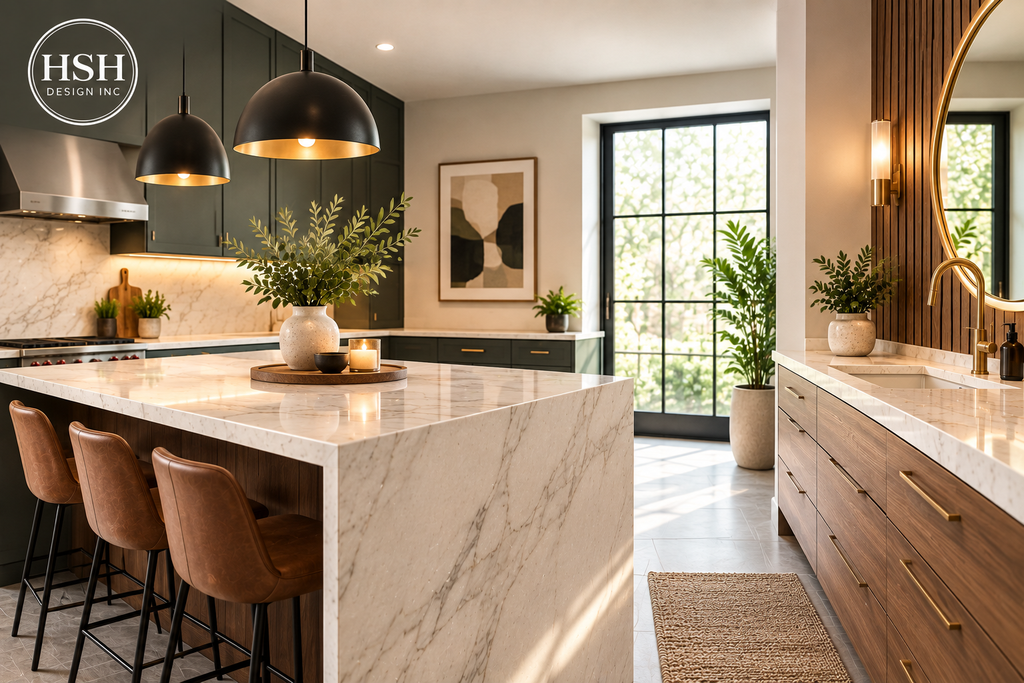
A visit to a stone countertop showroom in Lincoln can help you compare materials, examine colours and patterns, and understand how different surfaces will look in your home. Homeowners in Lincoln, Massachusetts, can explore countertop options and get design guidance from HSH Design Inc’s service area and showroom resources in Wilmington, Massachusetts. Understanding the differences between popular countertop materials before making a decision can help you avoid costly mistakes and choose a surface that works beautifully for years.
1. Which Stone Countertop Material Is Best for Your Home?
The best countertop material depends on your lifestyle, budget, and maintenance preferences. Quartz is popular for its consistent appearance and easy care, granite offers natural variation, marble provides classic elegance, and quartzite combines distinctive natural patterns with excellent hardness.
Before selecting a slab, consider where the countertop will be installed and how frequently the surface will be used.
Quartz Countertops: Low Maintenance and Consistent Design
Engineered quartz is manufactured using natural quartz particles and binding materials. It is available in a wide variety of colors, including designs that resemble marble, concrete, and other natural surfaces.
Quartz is nonporous, so it generally does not require sealing and resists everyday staining when properly maintained. However, it is not completely heatproof. Use trivets under hot cookware, follow the manufacturer’s cleaning instructions, and avoid prolonged exposure to high temperatures.
Quartz is a practical option for busy kitchens, family bathrooms, and homeowners who want a coordinated appearance without the regular sealing associated with some natural stones.
Granite Countertops: Natural Character and Durability
Granite is a natural stone known for its distinctive mineral patterns, color variations, and durability. Because each slab forms naturally, no two pieces have exactly the same appearance.
Granite works well in kitchens where the countertop must withstand regular food preparation. Depending on the specific stone and its finish, periodic sealing may be recommended to help reduce staining. Always ask about the particular slab’s porosity and care requirements.
Marble Countertops: Timeless Elegance
Marble is recognized for its soft veining and sophisticated appearance. It is particularly popular in traditional kitchens, upscale bathrooms, and spaces where natural patterning is an important design feature.
However, marble is more susceptible to etching from acidic substances such as lemon juice, vinegar, and certain household cleaners. It can also stain if spills are not handled appropriately. Homeowners who appreciate its appearance should be comfortable with careful maintenance and the possibility of developing a natural patina.
Quartzite and Porcelain: Additional Options
Natural quartzite offers distinctive patterns and strong surface hardness, making it worth considering for statement kitchen islands and elegant bathrooms. Its performance and maintenance requirements vary by slab, so verify that the stone is genuine quartzite and ask whether sealing is recommended.
Porcelain slabs provide another option for contemporary spaces. They can offer strong resistance to stains, heat, and UV exposure, depending on the product. Their installation and edge fabrication require appropriate expertise because thin slabs can be vulnerable to chipping during handling.
Homeowners comparing materials at a stone countertop showroom in Lynnfield can benefit from examining full-size slabs and discussing how each option performs under everyday conditions.
2. How Much Do Stone Countertops Cost, and What Affects the Price?
Stone countertop costs vary widely according to the material, slab selection, countertop dimensions, fabrication complexity, and installation requirements. The most useful way to compare quotes is to evaluate the complete installed cost rather than the price of the stone alone.
Your final estimate may include the following factors:
- Material selection: Standard quartz or granite options may cost less than premium, rare, or highly patterned slabs.
- Countertop dimensions: Larger kitchens and oversized islands generally require more material.
- Edge profiles: Simple edges are usually less expensive to fabricate than elaborate decorative profiles.
- Cutouts: Sink openings, cooktop cutouts, and faucet holes add fabrication work.
- Installation conditions: Access restrictions, difficult layouts, and removal of existing countertops can affect labor costs.
- Backsplashes and finishing: Matching backsplashes, additional side panels, and waterfall island edges can increase the project total.
- Plumbing and electrical work: Disconnecting or reconnecting fixtures may require separate qualified professionals.
There is no single price that accurately represents every countertop project. Request an itemized estimate that identifies the material, measured square footage, fabrication, installation, removal, and any additional work.
Homeowners exploring a stone countertop showroom in Melrose may also want to compare quotes using the same countertop measurements, material grade, edge profile, and installation scope. This makes it easier to determine whether a lower quote represents genuine savings or simply excludes necessary services.
How Can You Stay Within Your Countertop Budget?
Start by establishing a realistic project budget before selecting a slab. If a premium material exceeds your target, ask about alternative colours, standard thicknesses, simpler edges, or remnants that may suit a smaller vanity or bathroom project. It is also wise to confirm the location of seams before fabrication begins. The number and placement of seams depend on slab dimensions, countertop layout, material patterns, and structural considerations. Discussing these details early helps you understand the finished appearance and avoid unexpected changes.
3. What Are the Benefits of Choosing the Right Countertop?
The right countertop can improve daily functionality, simplify cleaning, and bring the entire room’s design together. Selecting a material that suits the space is often more valuable than choosing the most expensive stone available.
Consider these benefits when comparing your options:
- Everyday durability: Appropriate materials can handle routine cooking, cleaning, and bathroom use.
- Simpler maintenance: Nonporous surfaces such as engineered quartz generally require less routine care than some natural stones.
- Design flexibility: Colors, veining, finishes, and edge profiles help coordinate cabinets, flooring, hardware, and backsplashes.
- Better long-term planning: Understanding maintenance needs and installation costs can reduce avoidable expenses.
- A more cohesive interior: Matching the countertop with cabinetry and lighting creates a balanced, intentional appearance.
For smaller kitchens, lighter colors and restrained patterns can help create a more open visual effect. Larger kitchens may benefit from dramatic veining or a contrasting island, while bathroom vanities can use complementary colors to create a calm, coordinated design.
If you are comparing options through a stone countertop showroom in Middleton, bring cabinet samples, flooring references, and paint colors whenever possible. Viewing these elements together helps you judge undertones and contrast more accurately than relying on small online images.
Should Kitchen and Bathroom Countertops Use the Same Stone?
Not necessarily. A kitchen countertop may need to withstand frequent food preparation, cookware, and spills, while a bathroom vanity typically faces cosmetics, personal care products, and moisture.
Using the same material in both rooms can create visual consistency, but choosing different surfaces may better address each room’s practical needs. The decision should reflect maintenance expectations, design goals, and the specific products’ performance characteristics.
4. How Are Stone Countertops Selected and Installed?
A successful countertop project follows a series of planning, fabrication, and installation steps. Clear communication at each stage helps ensure that the finished surface fits correctly and performs as intended.
Step 1: Assess Your Space
Begin by identifying whether the countertop is for a kitchen, bathroom vanity, island, or another application. Consider daily use, sink placement, cabinet configuration, and the amount of available workspace.
Step 2: Compare Materials and Slabs
Review samples and, when possible, inspect full slabs before making your final choice. Natural stones vary in color, veining, and mineral composition, while engineered products can also vary between patterns and production batches.
Ask about the slab’s thickness, finish, maintenance instructions, warranty, and suitability for your intended application.
Step 3: Confirm Measurements and Layout
Accurate measurements are essential. A qualified countertop professional should verify dimensions, cabinet support, sink specifications, appliance locations, and cutout requirements before fabrication.
The layout should also account for seams, overhangs, edge profiles, and any special design features. Heavy stone surfaces require suitable cabinet support, so structural considerations should be addressed before installation.
Step 4: Fabricate the Countertop
The selected material is cut and finished according to the approved template. Sink openings, cooktop cutouts, edges, and seams are prepared using methods appropriate for the stone or engineered surface.
Fabrication professionals should follow the material manufacturer’s recommendations and applicable workplace safety practices. Stone cutting and polishing can generate hazardous respirable crystalline silica dust, so appropriate engineering controls, such as wet processing and suitable dust extraction, are important.
Step 5: Install and Inspect
Installers position the countertop, verify fit and support, and complete the necessary seam and edge finishing. Sink connections and plumbing work should be handled by appropriately qualified professionals where required.
Before the project is considered complete, inspect the surface, edges, seams, and cutouts. Confirm whether the selected stone needs sealing, obtain care instructions, and follow the manufacturer’s recommendations for cleaning and use.
What Quality and Safety Standards Should You Check?
Ask whether the selected material is appropriate for its intended use and whether its manufacturer provides installation, maintenance, and warranty documentation. For natural stone, request information about sealing and stain sensitivity; for engineered surfaces, review heat limitations and approved cleaning products.
There is no universal permit requirement for simply replacing every countertop. Requirements depend on the scope of work and local rules, particularly when plumbing, electrical systems, or structural elements are changed. Check with the relevant local building department when your renovation includes work beyond a straightforward surface replacement.
5. Why Choose HSH Design Inc for Countertop Planning in Lincoln?
Choosing a countertop is easier when material selection is considered alongside cabinetry, flooring, backsplashes, and the overall renovation plan. HSH Design Inc is a family-owned design center located at 442 Main Street, Wilmington, Massachusetts, serving homeowners and project partners in surrounding communities.
Its product and design offerings include countertop options alongside kitchen and bathroom renovation materials. Visiting the showroom can help Lincoln area homeowners compare available styles, discuss design considerations, and explore how different surfaces may work with their existing or planned interiors.
When planning a visit, consider bringing room measurements, cabinet samples, inspiration photos, and an estimated budget. Ask about material availability, fabrication arrangements, installation support, maintenance requirements, and the details included in your project estimate.
If you are researching a stone countertop showroom in North Andover as part of your comparison, use the same criteria to evaluate each option: product selection, guidance, quote transparency, material documentation, and coordination with your renovation schedule. Comparing services consistently helps you make an informed decision based on the needs of your home rather than promotional claims alone.
Conclusion:
The best stone countertop is one that complements your design, suits your everyday routine, and fits your renovation budget. Compare quartz, granite, marble, quartzite, and porcelain based on their maintenance requirements, durability, appearance, and installation needs before making your final decision.
A visit to a stone countertop showroom in Lincoln can help you evaluate real materials, coordinate colors with cabinetry, and understand the details that influence your finished project. Bring your measurements, design inspiration, and budget to make the selection process more productive.
Frequently Asked Questions
1. How do I choose the best stone countertop for my kitchen?
Choose a countertop based on durability, maintenance, appearance, and budget. Quartz is a popular low maintenance option, granite offers natural variation, and marble provides distinctive veining but requires more careful upkeep.
2. Where can I find a stone countertop showroom near me in Lincoln?
Lincoln homeowners can explore countertop materials and design options at a showroom serving the surrounding Massachusetts communities. Compare available materials, ask about fabrication and installation arrangements, and request a detailed estimate before committing.
3. How much do stone countertops cost in Lincoln, MA?
The cost depends on the material, slab size, edge profile, cutouts, and installation requirements. Request a customized quote that includes fabrication, installation, and any additional work so you can compare the total project cost accurately.
4. Is quartz better than granite for kitchen countertops?
Quartz generally requires less routine maintenance because it is nonporous and typically does not need sealing. Granite offers natural patterns and excellent durability, but its maintenance requirements vary by stone; neither material is completely resistant to damage.
5. Do natural stone countertops need to be sealed?
Many granite, marble, and quartzite countertops benefit from sealing, although requirements vary by stone and finish. Follow the supplier’s recommendations and remember that sealing can reduce staining but does not make a surface completely stainproof or prevent etching.